Wednesday, April 17, 2013

Op Amps II

The purpose of the lab is explore the effects of a varying input voltages, and feedback resistors on the output voltage on an inverting Op Amp.

Procedure:
We first consider this simple circuit.


Resistor
Nominal Value
Meaured Value
R_1
10 kΩ
9.91 kΩ
R_F
100 kΩ
97.7 kΩ


Building the Circuit

Finished circuit with the 12V rails

Using the pot, we varied V_in and recorded the output.

V_in (Desired)
V_in (Actual)
V_out (Measured)
V_RF (Measured)
I_op (Calculated)
0.25 V
0.24 V
-2.41 V
2.46 V
-0.0246 mA
0.5 V
0.50 V
-4.90 V
4.87 V
-0.0502 mA
1.0 V
1.00 V
-10.04 V
9.86 V
-0.1028 mA


I_cc = 0.874 mA
I_ee = -0.981 mA
I_cc + I_ee = -0.107 mA
P_cc = V*I = 10.488 mW
P_ee = 11.772 mW

Next we add a 1k resistor like shown below

Part 2 Circuit Diagram


The final circuit

However, we only took measurements when V_in = 1V.


V_in (Desired)
V_out (Measured)
V_RF (Measured)
I_op (Calculated)
I_cc (Measured)
I_ee (Measured)
1.0 V
-9.99 V
9.72 V
-0.102 mA
0.887 mA
-0.987 mA


I_ee + I_cc = -0.1 mA
P_cc = 10.644 mW
P_ee = 11.844 mW

Bonus:
R_f was swapped with a variable resistor
The gain becomes -5 when R_f = 50 kΩ
Measured R_f = 49.9


V_in (Desired)
V_out (Measured)
V_RF (Measured)
I_op (Calculated)
I_cc (Measured)
I_ee (Measured)
1.0 V
-5.03 V
4.99 V
-0.101 mA
0.885 mA
-0.985 mA


I_ee + I_cc = -0.1 mA

Conclusion:
The results are as expected because the ratio of the feedback resistors gives a gain of -10. V_in does not change the gain, only the resistors. KCL held, so the experiment was a success. To get a gain of 5, the ratio of R_i:R_f had to be 1:5, therefore R_f = 50 kΩ.

Thermometer sensor (Extra Credit)

The purpose of this lab is to amplify a thermosensor to a specific output range.

Prelab:
We start with the LM35 which produces 10 mV/°C.
We want to measure between 15 °C to 35 °C.
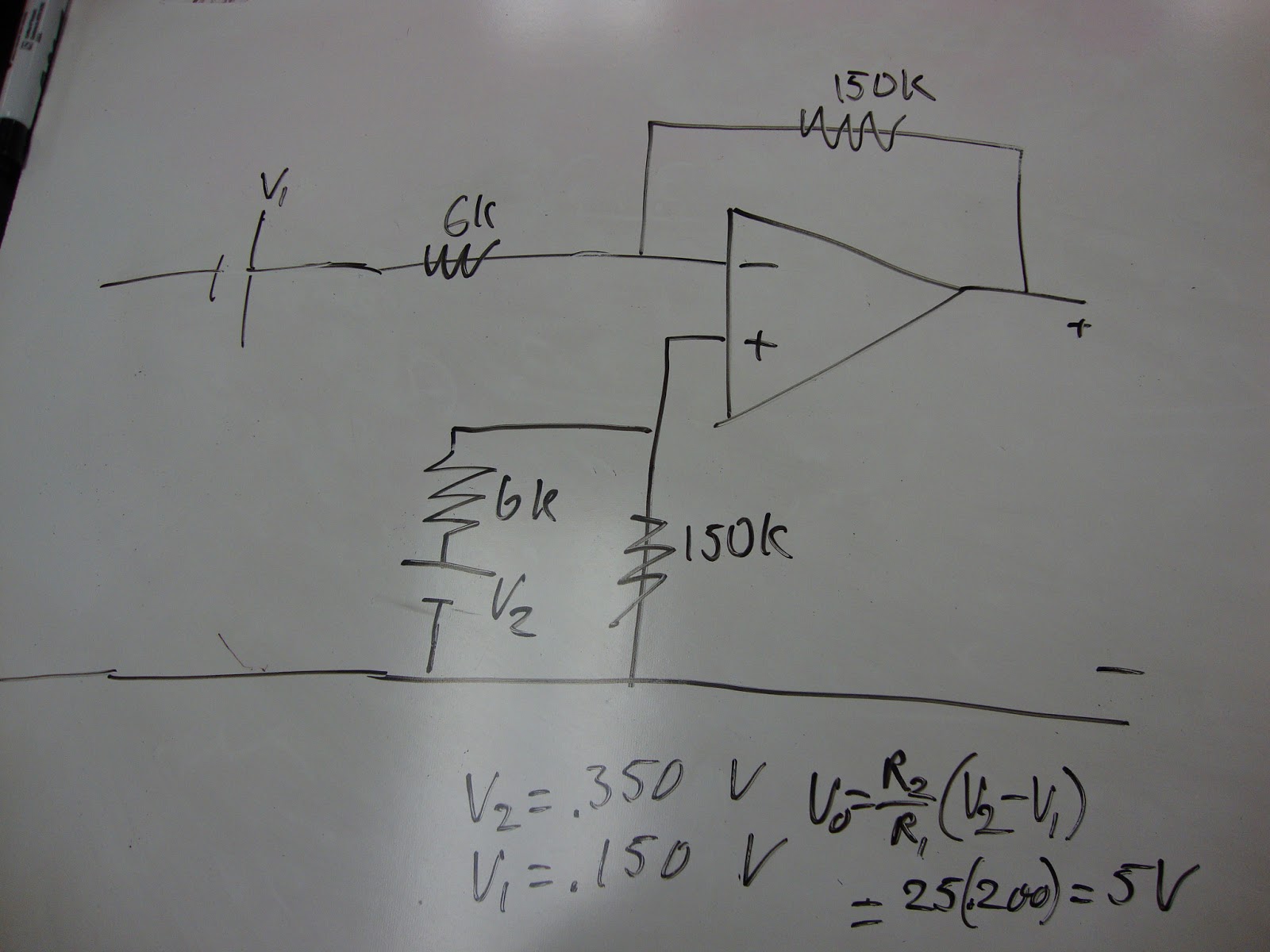
Using a difference amplifier, we shift and amplify the range of 150 mV - 350 mV to 0V - 5V.


To do so, we have V_2 = LM35, V_1 = 150 mV.
Our gain is 25, so R_f = 150 kΩ, and R_i = 6 kΩ.

Procedure: 
We start by building the circuit.

V_1 = Left pot, V_2 = Right pot
However to test the op amp, we made V_2 = 350 mV to see if the analysis was correct.


We then measure V_out = 5.05 V

Conclusion:
The lab was a success. We were able to use our opamp to amplify 350 mV correctly into 5V.

Sunday, April 7, 2013

Operational Amplifiers I

The purpose of the lab is to learn how to use an Op Amp to condition a signal from a voltage input into a specific voltage output.

Prelab:
We first start by analyzing our conditioning circuit.
We assume that:
V_cc = 12 V.
V_ee = -12 V.
V_in = 0 V to +1 V.
V_out = 0 V to -10 V.
The sensor outputs at most 1 mA.
The op-amp power supplies supply at most 30 mW each.

Using the information we determine that R_i = 1/1 V/mA = 1 kΩ.
Since the output is -10 V, the gain is 10. Thus R_f = 10*R_x = 10 kΩ.

However, the lab is limited to two power supplies so V_cc is also going to provide V_in using the appropriate voltage divider like the circuit below.


V = 12 V because it is the worst case where R_y is zero while using V_cc.
Using half of the power rating of a 1/4 W resistor, R_x = (V^2)*8 = (12^2)*8 = 1152 Ω.
With the voltage divider rule, R_y = R_x/11 = 104.7 Ω.

When finding the Thevenin Equivalents,
R_th = R_x*R_y/(R_x + R_y) = 96 Ω.
V_th = 1 V.
However, R_th is NOT 20 times under R_i.
Thus, the new R_i = 20*96 = 1.92 kΩ.
The new R_f = 19.2 kΩ.

Procedure:
We first measure the parts and build the circuit according to the two schematics.


Component
Nominal Value
Measured Value
Power or Current Rating
R_i
2000 Ω
1957 Ω
1/8 W
R_f
20000 Ω
19760 Ω
1/8 W
R_x
1152 Ω
1786 Ω
1/4 W
R_y
104.7 Ω
7020 Ω
1/4 W
V_1 = V_cc
12 V
12.12 Ω
2 A
V_2 = V_ee
12 V
12.08 Ω
2 A


Using two DMMs, we vary V_in and take measurements based on different V_in values.


V_in
V_out (Measured)
GAIN (Calculated)
V_Ri (Measured)
I_Ri (Calculated)
V_Rf (Measured)
0.0 V
0.00 V
0.00
0.00 V
0.00 A
0.00 V
0.25 V
-2.55 V
-10.20
0.25 V
0.125 mA
2.57 V
0.50 V
-5.07 V
-10.14
0.50 V
0.250 mA
5.11 V
0.75 V
-7.62 V
-10.16
0.75 V
0.375 mA
7.65 V
1.00 V
-10.16 V
-10.06
1.01 V
0.505 mA
10.18 V


I_v1 = 2.31 mA
I_v2 = -1.645 mA

Analysis:
P_v1 = V*I = 28.00 mW
P_v2 = -19.87 mW

I_v1 + I_v2 = 0.665 mA
I_f = 0.509 mA
Error = 30.6%

Conclusion:
The experiment was a success. The power constraint was under 30 mW. To reduce the power even further and keep the -10 gain, it is better to reduce the resistance R_i and R_f as long as their ratio of R_f/R_i = 10.